Arthroscopic shoulder surgery
Rotator cuff repair
Repair of a torn tendon back to bone using small incisions and suture anchors when appropriate.
During arthroscopic rotator cuff repair, a camera and specialized instruments are placed through small incisions. The torn tendon is mobilized and secured to its footprint on the humerus. The exact repair depends on tear shape, size, tissue quality, and associated shoulder findings.
See the anatomy and imaging

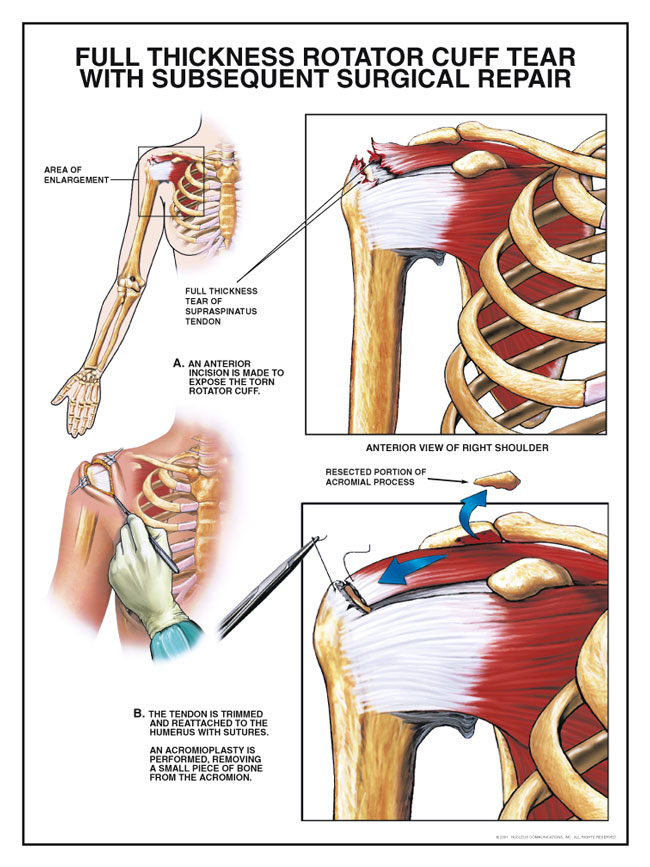
Repair anatomy and goals
The goal is to restore the tendon’s attachment to the greater or lesser tuberosity with appropriate tension while preserving healthy tissue. The procedure cannot make chronically changed tendon and muscle biologically new, so repairability and expected healing are assessed before and during surgery.
Who may benefit
Repair may be considered for an acute traumatic tear, substantial weakness, a symptomatic repairable tear that has not improved with nonsurgical care, or functional loss that is unacceptable to the patient. Age alone does not decide treatment; tear pattern, muscle quality, health, smoking, diabetes, goals, and rehabilitation capacity all matter.
What may be addressed
- Inflamed or damaged bursal and labral tissue
- Biceps tendon disease when clinically important
- Bone spurs or impingement in selected cases
- The tendon tear with an individualized anchor and suture construct
How arthroscopic repair works
After the tear is visualized and mobilized, the bone attachment is prepared and suture anchors are placed. Sutures pass through the tendon and secure it back to its footprint. Single-row, double-row, margin-convergence, augmentation, or partial-repair strategies may be used according to anatomy and tissue quality.
Weeks 0–2: protect the repair
Wear the sling and bolster at all times, including while sleeping, unless Dr. Ramirez tells you otherwise. Bend and straighten the elbow, wrist, and fingers several times daily, squeeze the ball attached to the sling, and perform scapular squeezes. Pendulums are allowed only if Dr. Ramirez permits them. Do not actively lift the arm, reach behind your back, or lift more than a coffee cup.
Weeks 2–6: passive motion
Formal physical therapy usually starts after the first postoperative visit at about 14 days. Begin gentle passive range of motion only as directed by Dr. Ramirez or your therapist. Continue the sling for the prescribed 4–6 weeks. Do not actively lift the arm, push or pull with the operative arm, or reach overhead.
Weeks 6–12 and months 3–6
Active motion begins as directed during weeks 6–12. Light strengthening after a cuff repair usually starts around week 12. During months 3–6, strengthening and return to activity progress gradually. Most patients feel close to normal by 4–6 months, but improvement can continue for up to a year. A repaired tendon needs roughly 12 weeks to heal back to bone.
Wound care, sleep, and driving
Remove the shoulder wrap after 72 hours but leave Steri-Strips in place. You may shower after 72 hours if the incisions remain covered and dry; do not soak for at least 4 weeks and until they are fully healed. A recliner or propped-up position is usually most comfortable for 1–2 weeks. Do not drive while taking narcotics or wearing the sling; most patients resume driving at 2–4 weeks when they feel safe.
Healing expectations
Pain and function often improve even when imaging later shows incomplete structural healing, but a healed tendon generally provides the best foundation for strength. Re-tear risk rises with larger chronic tears, muscle atrophy, smoking, diabetes, and increasing age. Following protection and therapy instructions is part of the treatment.
Risks
- Stiffness or persistent pain
- Re-tear or incomplete tendon healing
- Infection, nerve injury, blood clot, or anesthesia complication
- Need for additional treatment or surgery
Evidence and further reading
- AAOS OrthoInfo: Rotator Cuff Surgical Treatment Options
- AAOS 2025 Clinical Practice Guideline: Rotator Cuff Injuries
- AAOS Surgical Video: Arthroscopic Rotator Cuff Repair
Educational content is reviewed for patient clarity and is not a substitute for an examination or individualized medical advice.
PIA Shoulder MD